There’s a new conversation creeping into crypto and it’s not about ETFs or macro.
It’s quantum.
A recent paper from Google’s quantum research team has brought this topic back into focus, suggesting the timeline for breaking current cryptography may be closer than previously expected.
That matters because Bitcoin’s security is built on that exact math.
Right now, it’s effectively impossible to reverse a public key into a private key. That’s what keeps your funds safe.
Quantum changes that assumption.
Bitcoin actually hides your public key by default but the moment you send a transaction, it gets exposed.
Under normal conditions, no issue.
In a quantum scenario, that creates a potential window where:
- A public key is visible
- A private key could be derived
- And a competing transaction could be submitted before confirmation
It’s not a today problem but it’s no longer a zero-probability one either.
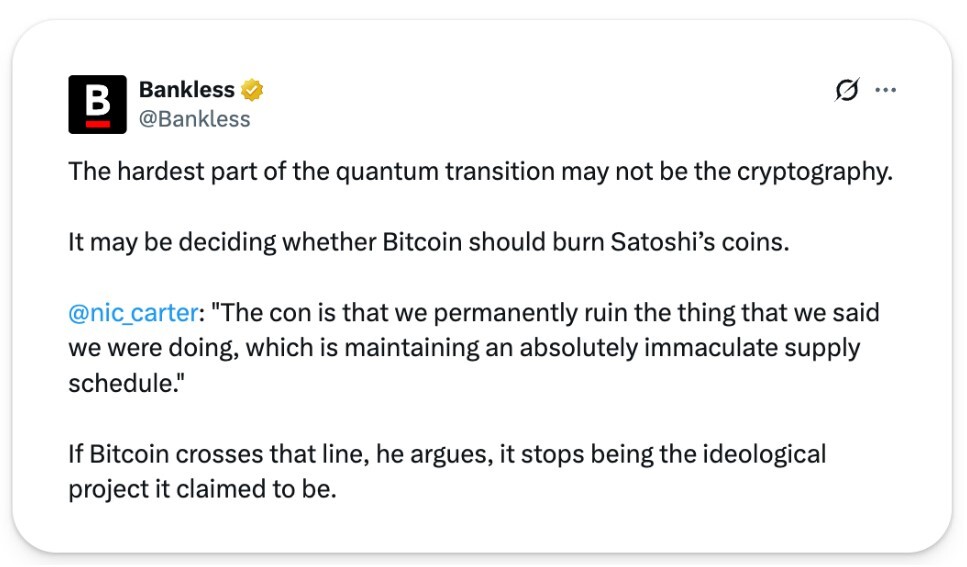
Then there’s the Satoshi problem
Roughly 6.9 million BTC sits in wallets with exposed public keys. Around 2.3 million of that is believed to be lost or tied to early wallets.
These coins are different.
They aren’t just exposed during a transaction. They’re exposed all the time.
If quantum reaches that level:
- These wallets could theoretically be accessed
- Long-dormant coins could suddenly move
- And markets would have to absorb that potential supply
So what happens then?
There’s no agreed solution. Some ideas floating around:
- Do nothing and let the market decide
- Burn vulnerable coins
- Limit how they can move
- Or upgrade the network to quantum-resistant cryptography
Each comes with trade-offs and none are simple to implement.